How to Select a Laboratory Nitrogen Generator
A practical guide to choosing the right nitrogen generator for laboratories, analytical instruments and scientific applications
Nitrogen is one of the most widely used gases in modern laboratories. It can be used as an instrument gas, carrier gas, purge gas, drying gas, nebulising gas or source gas for analytical instruments. Applications range from gas chromatography and liquid chromatography to mass spectrometry, sample preparation, gloveboxes and general laboratory processes. Traditionally, laboratories have relied on compressed nitrogen cylinders or bulk liquid nitrogen.
A laboratory nitrogen generator provides an alternative by producing nitrogen on demand from compressed air. However, selecting the right generator is not simply a matter of choosing the highest nitrogen purity available. The generator needs to provide the required:
- Nitrogen purity
- Flow rate
- Outlet pressure
- Dew point
- Hydrocarbon level
- Oxygen concentration
- Reliability
- Operating continuity
- Noise level
- Physical size
- Maintenance requirements
The most appropriate generator is therefore determined by the application and the requirements of the connected equipment.
What is a laboratory nitrogen generator?
A nitrogen generator separates nitrogen from compressed air and supplies the nitrogen continuously to laboratory equipment. Atmospheric air contains approximately 78% nitrogen, with oxygen and other gases making up most of the remainder. A nitrogen generator separates the nitrogen from these other components. A simplified system is:
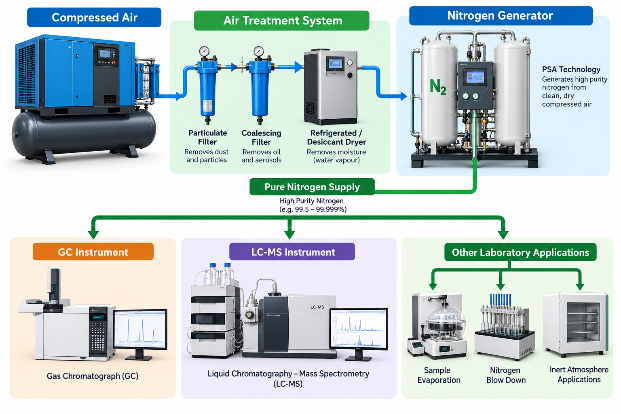
The generator may incorporate filtration, drying, separation, storage and pressure-control components depending on its design.
Why use a nitrogen generator?
A nitrogen generator can eliminate or reduce the need to regularly replace nitrogen cylinders. Potential advantages include:
- On-demand nitrogen production
- Continuous supply
- Reduced cylinder handling
- Reduced cylinder storage
- Less dependence on gas deliveries
- Consistent gas supply
- Potentially lower long-term operating costs
- Easier integration with laboratory instruments
However, a generator also introduces additional equipment that requires electricity, compressed air and maintenance. The economics therefore depend on the laboratory's actual nitrogen consumption.
The first question: what will the nitrogen be used for?
The application should be established before selecting the generator.
Different laboratory instruments have very different nitrogen requirements.
For example:
Gas chromatography
Nitrogen may be used as:
- Carrier gas
- Make-up gas
- Detector gas
- Purge gas
LC-MS
Nitrogen can be used for:
- Nebulisation
- Desolvation
- Drying
- Other instrument-specific functions
Sample preparation
Nitrogen may be used to evaporate solvents or concentrate samples.
Gloveboxes
Nitrogen may be used to maintain a controlled atmosphere.
General laboratory use
Nitrogen may be required for:
- Purging
- Blanketing
- Drying
- Inerting
- Equipment operation
The required purity and flow can be very different for each application.
Nitrogen purity
Purity is one of the most important generator specifications. A generator may be described as producing nitrogen at a particular purity, for example:
- 95%
- 99%
- 99.5%
- 99.9%
- 99.99%
- 99.999%
The appropriate purity depends entirely on the application. A laboratory should therefore avoid automatically purchasing a generator with the highest possible purity.
Higher purity can require additional separation capacity and may affect generator size, compressed-air consumption and operating cost. The objective should be:
Select the purity required by the application, with an appropriate engineering margin.
Do not consider purity alone
A nitrogen specification should not be reduced to one number.
Other important parameters may include:
- Oxygen concentration
- Moisture content
- Hydrocarbon concentration
- Carbon dioxide
- Particulate contamination
- Dew point
For sensitive analytical instruments, trace contaminants can sometimes be more important than the headline nitrogen purity. The instrument manufacturer's gas specifications should therefore be checked before selecting a generator.
Flow rate is critical
A generator must produce enough nitrogen for the connected equipment.
The required flow depends on the instruments and their operating modes.
For example:
| Instrument | Required flow |
|---|---|
| Instrument 1 | 1.0 L/min |
| Instrument 2 | 2.0 L/min |
| Instrument 3 | 1.5 L/min |
| Total | 4.5 L/min |
The generator should not necessarily be selected for exactly 4.5 L/min.
An appropriate capacity margin should be provided for:
- Start-up conditions
- Peak demand
- Future instruments
- Pressure losses
- Generator performance variation
The actual flow requirements must be obtained from the instrument manufacturers.
Peak flow vs average flow
This distinction is important. An instrument may have a relatively low average nitrogen consumption but require a substantially higher flow under certain operating conditions. A generator should therefore be sized according to the maximum required operating flow, not simply the average. For laboratories with several instruments, the operating schedules should also be considered. If all instruments can operate simultaneously, the generator must be capable of supporting their combined demand.
Outlet pressure
Flow alone does not define the gas supply requirement. The generator must also provide nitrogen at the required pressure. For example, an instrument may require:
- A minimum inlet pressure
- A particular operating pressure
- A regulated pressure range
The generator specification should therefore be checked against the instrument requirements.
Pressure regulators may be required between the generator and individual instruments.
Dew point and moisture
Water vapour can be important in analytical applications. The nitrogen generator should therefore be evaluated for its specified moisture content or pressure dew point.
A low dew point may be particularly important where nitrogen is used for:
- Sensitive analytical instruments
- Drying
- Sample preparation
- Inert atmospheres
- Moisture-sensitive processes
The required specification depends on the application.
Hydrocarbon contamination
Hydrocarbon contamination can be important for analytical applications. For example, sensitive chromatographic or mass-spectrometry applications may require very low hydrocarbon levels. The nitrogen generation system should therefore include appropriate air treatment and purification where required. The specification should state the actual expected contaminant level rather than simply relying on a general statement such as "high-purity nitrogen."
How nitrogen generators work
Several technologies are available. The most common approaches for laboratory and industrial nitrogen generation include:
- PSA — Pressure Swing Adsorption
- Membrane separation
- Cryogenic separation
For most laboratory-scale applications, PSA and membrane systems are the technologies most likely to be considered.
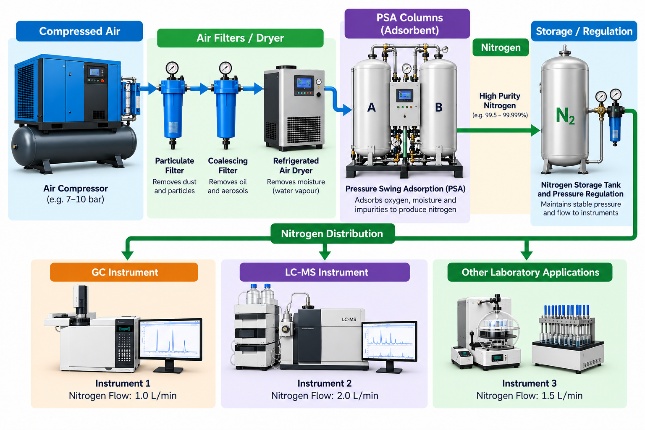
PSA nitrogen generators
PSA systems use an adsorbent material that preferentially retains certain components of compressed air. PSA generators commonly use alternating adsorption vessels. While one vessel is producing nitrogen, another can undergo regeneration. This allows continuous nitrogen production.
Membrane nitrogen generators
Membrane systems use selective gas permeation to separate components of compressed air. A representative arrangement is:
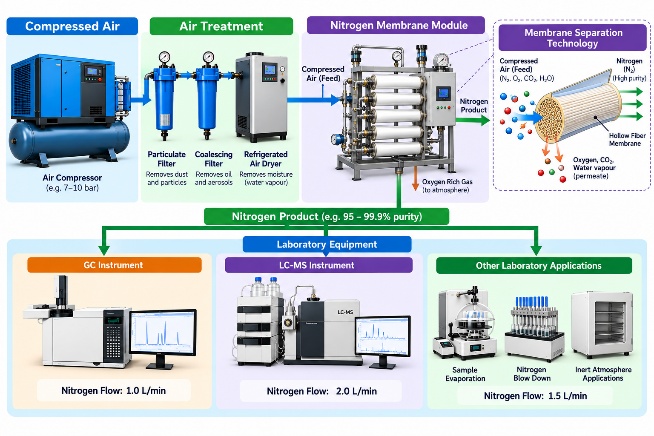
Membrane systems can be compact and mechanically simple. However, achievable nitrogen purity and recovery depend on membrane design, pressure and operating conditions. They can be particularly attractive for applications where extremely high nitrogen purity is not required.
Cryogenic nitrogen
Cryogenic separation is used for large-scale nitrogen production. Air is cooled to very low temperatures and separated into its principal components. Cryogenic systems can provide very large quantities of high-purity nitrogen but are generally not the first choice for a small laboratory requiring a modest gas flow. For most laboratory installations, PSA or membrane technologies are more practical.
PSA vs membrane
| Characteristic | PSA | Membrane |
|---|---|---|
| Separation principle | Adsorption | Selective permeation |
| Typical use | Higher-purity nitrogen | Low to moderate purity applications |
| Mechanical complexity | Moderate | Relatively simple |
| Moving parts | Valves required | Few moving parts |
| Maintenance | Filters, valves, adsorbent system | Filters and membrane system |
| Size | Depends on capacity | Often compact |
| Purity range | Broad | Application dependent |
| Air consumption | Application dependent | Application dependent |
These are general characteristics. Actual performance varies considerably between manufacturers and generator designs.
Selecting the right technology
The choice between PSA and membrane technology should be based on the required:
Purity + flow + pressure + dew point + operating hours + cost For applications requiring very high nitrogen purity, PSA technology may be more appropriate. For applications where moderate purity is sufficient and simplicity and compactness are important, membrane technology may be attractive. The manufacturer's actual specifications should always be checked.
Nitrogen generators for GC
Gas chromatography is one of the most common laboratory applications for nitrogen.
Depending on the GC configuration, nitrogen may be used as:
- Carrier gas
- Make-up gas
- Detector gas
- Purge gas
The generator must be selected according to the GC manufacturer's requirements.
Important specifications include:
- Nitrogen purity
- Flow rate
- Pressure
- Moisture
- Hydrocarbon level
For a laboratory with multiple GC instruments, the combined demand should be calculated.
Nitrogen generators for LC-MS
Mass spectrometry applications can have substantially different nitrogen requirements. Nitrogen may be used for:
- Nebulisation
- Desolvation
- Drying
- Instrument source functions
Some LC-MS instruments can consume considerably more nitrogen than a conventional GC system. The generator must therefore be sized according to the instrument's specified gas flow and pressure requirements. A generator suitable for one GC should not automatically be assumed to be suitable for an LC-MS system.
Nitrogen generators for sample evaporation
Nitrogen is frequently used to evaporate solvents during sample preparation.
In these applications, the required flow can be substantial. The generator should therefore be sized for the actual number of evaporation stations and their simultaneous operating requirements. Where large volumes of nitrogen are required continuously, compressed-air consumption should also be considered.
Nitrogen for gloveboxes and inert atmospheres
Gloveboxes and controlled-atmosphere equipment can require nitrogen for maintaining an inert environment. In these applications, the generator may need to supply:
- Initial purge gas
- Continuous make-up gas
- Gas for pressure control
The required flow during initial purging can be substantially higher than the normal operating flow. This distinction should be included in the generator-sizing calculation.
Compressed air is part of the system
One of the most commonly overlooked considerations is that a nitrogen generator requires a suitable source of compressed air. The complete system may look like this:
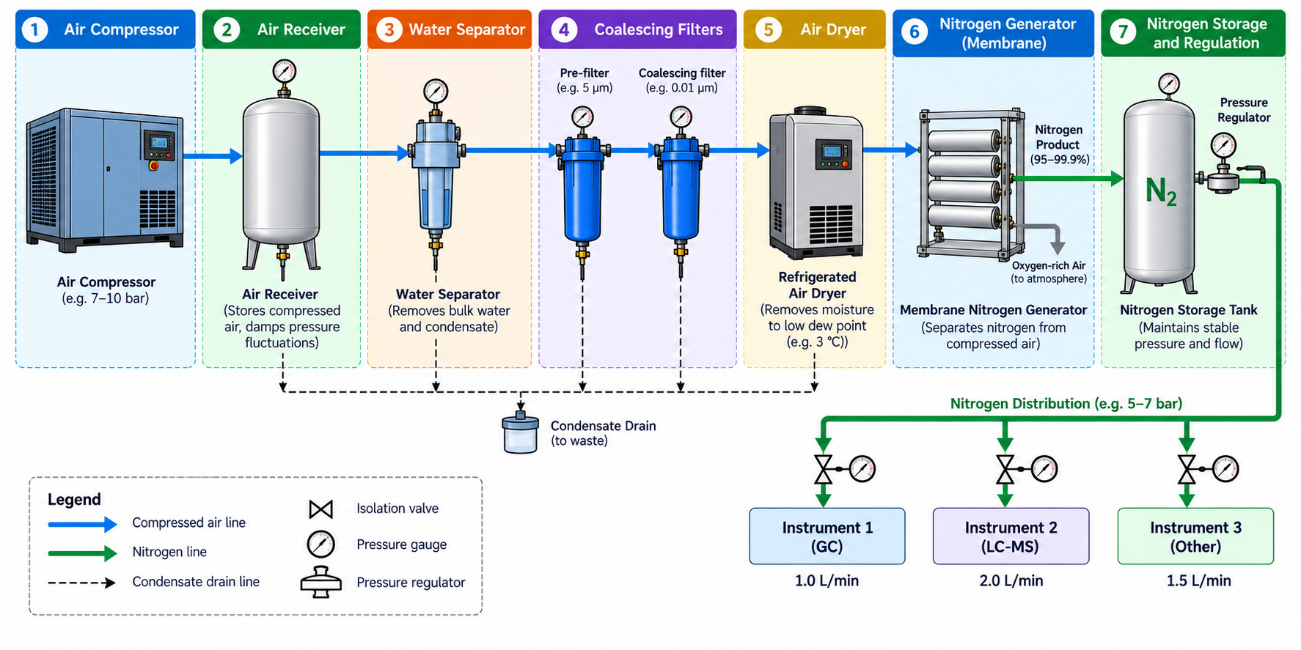
The compressor should be capable of providing the required air pressure and flow continuously.
Air quality matters
Compressed air entering the nitrogen generator must meet the generator manufacturer's requirements. Problems with the air supply can affect generator performance and service life. Potential contaminants include:
- Oil
- Water
- Particulates
- Aerosols
- Hydrocarbons
Appropriate filtration and drying should therefore be included in the system design.
An oil-lubricated compressor may require additional treatment if the generator requires oil-free or very low-hydrocarbon feed air.
Integrated or separate compressor?
Some laboratory nitrogen generators incorporate an air compressor. Others require a separate compressed-air supply. An integrated compressor can simplify installation.
A separate compressor can provide greater flexibility and may be preferable where several generators or other laboratory systems already use compressed air. The comparison should consider:
- Noise
- Heat generation
- Space
- Maintenance
- Compressor capacity
- Redundancy
- Future expansion
Storage capacity
A nitrogen generator does not necessarily need to supply every instantaneous peak directly. A buffer or storage vessel can help manage short-term changes in demand.
For example:
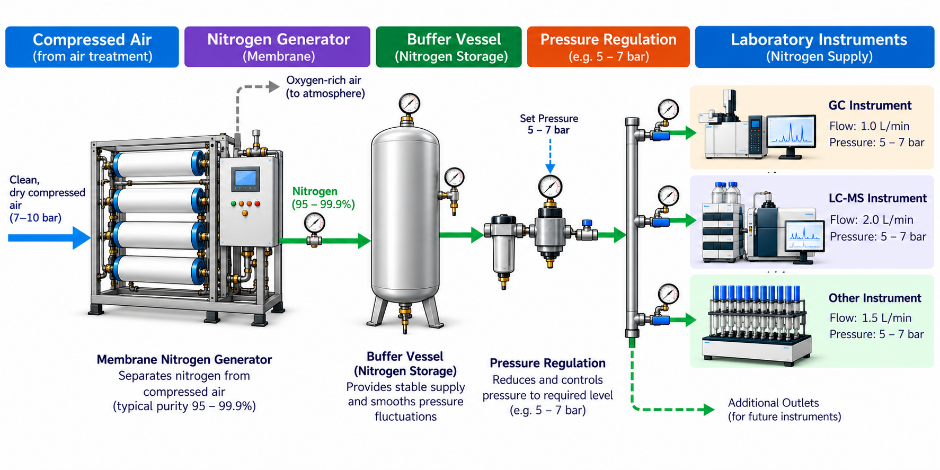
Storage capacity should be designed according to the generator characteristics and application.
Redundancy for critical laboratories
For critical analytical operations, a single nitrogen generator may represent a single point of failure. Possible strategies include:
- Standby generator
- Backup nitrogen cylinder
- Dual-generator arrangement
- Nitrogen storage buffer
- Automatic changeover
- Critical-instrument prioritisation
The appropriate arrangement depends on the consequences of nitrogen supply failure.
For a non-critical laboratory, a backup cylinder may be sufficient.
For a highly critical process, a more sophisticated redundant system may be justified.
What happens during a power failure?
Most laboratory nitrogen generators require electricity. If electrical power is lost, nitrogen generation will normally stop. A laboratory should consider what happens to connected instruments during a power interruption. Potential solutions include:
- UPS systems
- Backup nitrogen supply
- Emergency procedures
- Automatic shutdown
- Generator redundancy
The correct solution depends on the equipment and the consequences of interruption.
Noise and heat
A laboratory nitrogen generator can generate both noise and heat. If the system incorporates an air compressor, the compressor may be the main source of noise.
Heat generated by the compressor and generator can also affect the laboratory environment. Before installation, consider:
- Room ventilation
- Generator location
- Noise level
- Ambient temperature
- Access for maintenance
A technically suitable generator may still be unsuitable if it creates an unacceptable laboratory environment.
Physical size and installation
Consider the complete footprint rather than just the generator enclosure. The installation may require space for:
- Generator
- Compressor
- Air dryer
- Filters
- Buffer tank
- Nitrogen storage
- Regulators
- Gas distribution
- Electrical connections
Adequate access should be provided for maintenance.
Maintenance requirements
A nitrogen generator is not maintenance-free. Depending on the technology, maintenance may include:
- Air-filter replacement
- Coalescing-filter replacement
- Dryer maintenance
- Compressor servicing
- Valve inspection
- Membrane replacement
- PSA adsorbent servicing
- Drain maintenance
- Leak testing
Maintenance intervals vary by manufacturer and operating conditions. The expected maintenance schedule should therefore be evaluated before purchase.
Energy consumption
The cost of nitrogen generation is closely related to compressed-air production. The compressor may consume considerably more energy than the separation system itself.
Important parameters include:
- Nitrogen flow
- Required purity
- Feed-air pressure
- Compressor efficiency
- Generator efficiency
- Operating hours
A generator that produces nitrogen efficiently at the required specification can have significantly different operating costs from one that consumes excessive compressed air.
Calculate the total cost of ownership
The purchase price should not be the only financial consideration.
A useful calculation is:
Total cost of ownership includes:
- Compressor cost
- Installation
- Electricity
- Maintenance
- Filters and consumables
- Replacement components
- Service costs
This should be compared with the cost of purchasing nitrogen cylinders or liquid nitrogen over the expected operating period.
Cylinder vs nitrogen generator
| Consideration | Nitrogen Cylinder | Nitrogen Generator |
|---|---|---|
| Gas source | Stored nitrogen | Produced from air |
| Gas delivery | Required | Reduced |
| Cylinder handling | Required | Generally eliminated |
| Electricity | Not required for gas storage | Required |
| Compressed air | Not required | Required |
| Installation | Relatively simple | More complex |
| Initial investment | Usually lower | Usually higher |
| Ongoing gas logistics | Required | Minimized |
| Maintenance | Cylinder/regulator system | Generator + compressor system |
| Continuous supply | Limited by cylinder capacity | Within generator capacity |
| Backup requirement | Replacement cylinder | Backup gas or generator |
| Best suited to | Low/intermittent demand | Regular/continuous demand |
Common mistakes when selecting a nitrogen generator
Choosing purity before understanding the application
The highest purity is not necessarily the most appropriate choice.
Ignoring flow requirements
A generator that meets the purity specification but cannot supply sufficient flow is unsuitable.
Ignoring peak demand
Average consumption may substantially underestimate the required capacity.
Forgetting compressed-air requirements
The nitrogen generator is only one part of the system.
Ignoring dew point
Moisture requirements should be established for the connected equipment.
Ignoring hydrocarbons
Sensitive analytical applications may have strict contamination requirements.
Choosing a generator without considering future expansion
A laboratory may add instruments over time. A modest amount of spare capacity can be valuable.
Failing to plan for power failure
A generator cannot produce nitrogen without the required electrical power.
Treating the generator as maintenance-free
Filters, compressors, dryers and separation systems require periodic attention.
A practical selection process
A laboratory can use the following process.
Step 1 — List all applications
Identify every instrument or process requiring nitrogen.
Step 2 — Determine gas specifications
Record:
- Purity
- Flow
- Pressure
- Dew point
- Hydrocarbon specification
Step 3 — Calculate simultaneous demand
Determine the maximum likely combined nitrogen demand.
Step 4 — Add appropriate capacity margin
Allow for operating variation and future requirements.
Step 5 — Select the generation technology
Compare PSA, membrane or other appropriate technologies.
Step 6 — Design the compressed-air system
Confirm compressor capacity, filtration and drying.
Step 7 — Evaluate installation requirements
Consider space, ventilation, noise, heat and access.
Step 8 — Calculate lifecycle cost
Compare generation against cylinder or bulk-gas supply.
Step 9 — Plan redundancy
Determine what happens if the generator or power supply fails.
Step 10 — Verify compatibility
Confirm that the final system meets the requirements of every connected instrument.
Example: selecting a generator for a small analytical laboratory
Consider a laboratory with:
- Two GC instruments
- One LC-MS system
- One nitrogen evaporation system
The first step is not to purchase a generator. Instead, the laboratory should obtain the gas specifications from each instrument. A table can then be prepared:
| Application | Purity | Flow | Pressure |
|---|---|---|---|
| GC 1 | Manufacturer specification | Required flow | Required pressure |
| GC 2 | Manufacturer specification | Required flow | Required pressure |
| LC-MS | Manufacturer specification | Required flow | Required pressure |
| Evaporator | Application specification | Required flow | Required pressure |
The maximum simultaneous demand can then be calculated. Only after this calculation should generator capacity be selected.
Monitoring the nitrogen generator
Modern generators can themselves become IoT-enabled laboratory assets.
Parameters that can potentially be monitored include:
- Nitrogen pressure
- Nitrogen flow
- Purity
- Compressor status
- Air pressure
- Temperature
- Filter status
- Generator status
- Fault conditions
- Operating hours
A monitoring architecture could be:
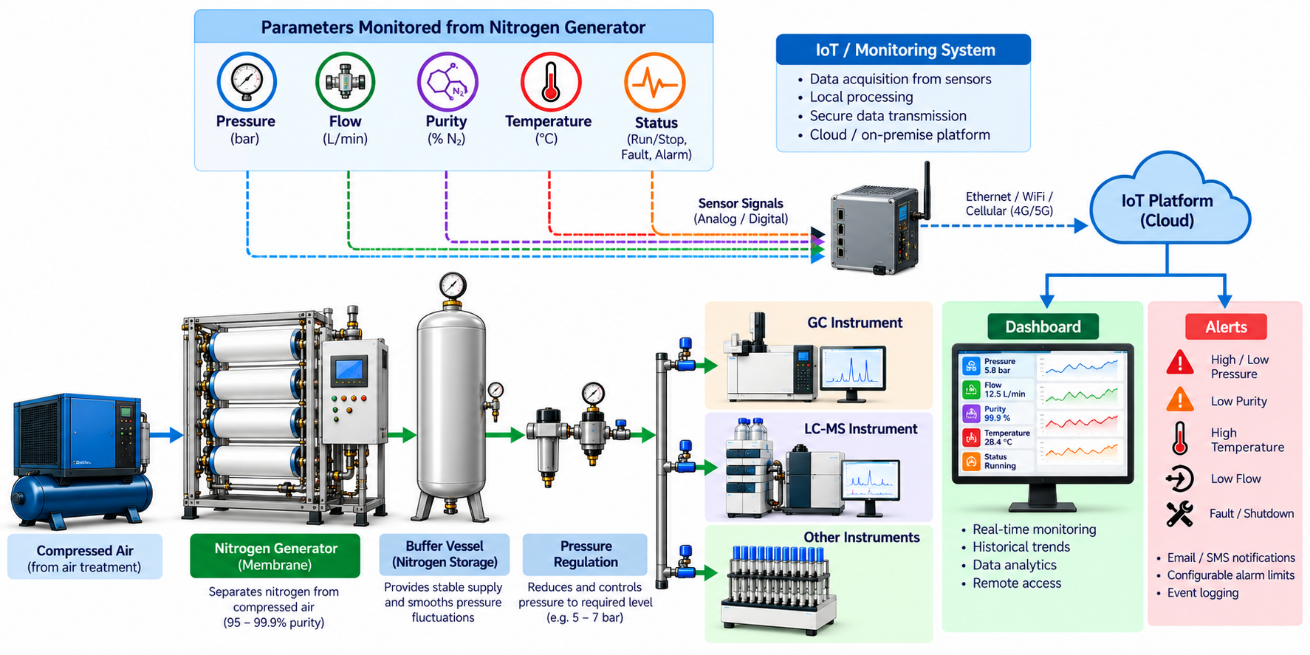
This can help laboratory personnel identify problems before they interrupt instrument operation.
Selecting a supplier
When evaluating a nitrogen-generator supplier, ask for more than a brochure specification. Important questions include:
- What purity is guaranteed?
- At what flow rate?
- At what inlet pressure?
- What is the specified dew point?
- What are the residual oxygen levels?
- What are the hydrocarbon levels?
- What compressed-air quality is required?
- What compressor capacity is required?
- What are the maintenance intervals?
- What consumables are required?
- What is the expected service life?
- What happens during a power failure?
- Is backup gas recommended?
- What local service support is available?
- Can the system be expanded?
- What monitoring and alarm outputs are available?
These questions can reveal significant differences between apparently similar generators.
Final considerations
Selecting a laboratory nitrogen generator should begin with the application, not the generator catalogue. The key requirements are:
Purity + flow + pressure + moisture + contamination + reliability
These should then be matched with:
Generation technology + compressed-air system + storage + regulation + maintenance + backup
For laboratories using nitrogen regularly, on-demand generation can provide an attractive alternative to cylinders, particularly where gas consumption is substantial or cylinder handling is inconvenient. However, a nitrogen generator is part of a complete gas-supply system. Compressor capacity, air quality, filtration, drying, pressure regulation, installation conditions and maintenance all affect the final result. The best generator is therefore not necessarily the one with the highest purity or largest capacity. It is the one that reliably produces the gas specification required by the laboratory at the required flow and pressure, while providing an appropriate balance of capital cost, operating cost, maintenance and reliability.
Novel Aquatech can support the evaluation of laboratory gas-generation technologies and the development of specialised laboratory equipment and monitoring solutions according to the requirements of individual applications.
Laboratory nitrogen-generator selection checklist
- Identify every nitrogen-consuming application
- Obtain manufacturer gas specifications
- Determine required nitrogen purity
- Determine required flow rate
- Determine peak simultaneous demand
- Determine required pressure
- Determine dew-point requirement
- Determine hydrocarbon specification
- Determine oxygen specification
- Select appropriate generation technology
- Verify compressed-air requirements
- Select suitable compressor
- Provide appropriate filtration and drying
- Consider buffer/storage capacity
- Evaluate generator noise and heat
- Check available laboratory space
- Calculate electricity consumption
- Calculate maintenance costs
- Compare lifecycle cost with cylinders
- Consider future instrument expansion
- Plan backup supply
- Consider generator monitoring and alarms
- Verify compatibility with laboratory instruments