Hydrogen Generators vs Gas Cylinders for Gas Chromatography
Comparing hydrogen supply options for gas chromatography laboratories
Hydrogen is widely used in gas chromatography (GC), particularly as a carrier gas and as a fuel gas for flame-based detectors such as the flame ionisation detector (FID).
Traditionally, laboratories have supplied hydrogen from compressed-gas cylinders.
However, hydrogen generators provide an alternative method of producing hydrogen on demand, using water and electricity. For laboratories operating GC instruments regularly, the choice between cylinders and a hydrogen generator involves more than simply comparing the cost of hydrogen. Factors such as purity, supply continuity, laboratory space, safety, maintenance, gas consumption and operational convenience also need to be considered.
This article compares hydrogen generators and gas cylinders for GC applications and discusses the circumstances in which each approach may be appropriate.
Why is hydrogen used in gas chromatography?
Hydrogen has several applications in GC.
It can be used as:
- A carrier gas
- A fuel gas for an FID
- A fuel gas for other hydrogen-flame detectors
- A gas for certain specialised GC applications
When hydrogen is used as a carrier gas, it transports the sample through the GC column.
When it is used as an FID fuel, hydrogen is combined with air to produce the flame required for detection.
The required hydrogen flow rate and purity depend on the GC instrument, detector and analytical method.
Hydrogen cylinders for GC
Compressed hydrogen cylinders have been the conventional method of supplying hydrogen to laboratories. A cylinder contains hydrogen stored at high pressure. A suitable regulator and gas-delivery system reduce the pressure to the level required by the GC system.
A typical arrangement is shown below
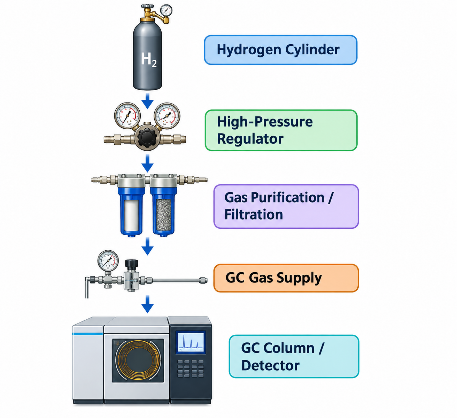
Cylinder systems are well established and can provide a reliable supply when properly installed and managed.
However, laboratories need to manage cylinder storage, delivery, replacement and associated safety procedures.
Hydrogen generators for GC
A hydrogen generator produces hydrogen on demand rather than storing a large quantity of hydrogen in a cylinder.
One commonly used technology is PEM/SPE electrolysis.
In a simplified system:
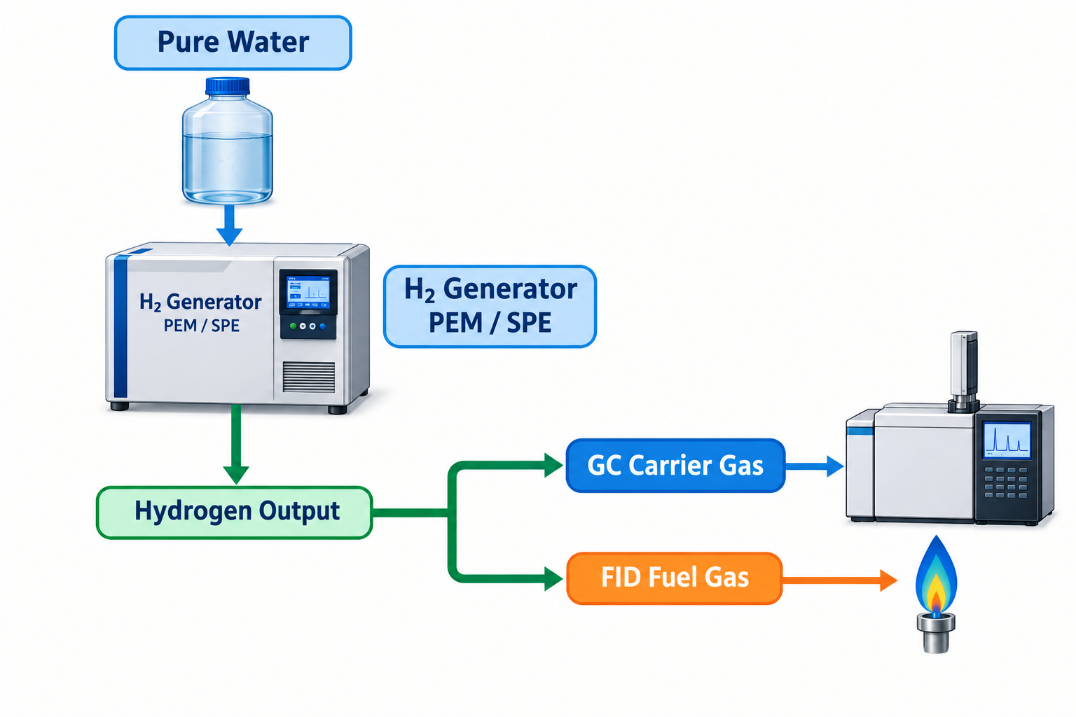
The generator uses electricity to split water into hydrogen and oxygen.
Because hydrogen is generated as required, there is no need to store a large volume of compressed hydrogen at the point of use.
Hydrogen generator vs cylinder: at a glance
| Consideration | Hydrogen Cylinder | Hydrogen Generator |
|---|---|---|
| Hydrogen source | Pre-filled cylinder | Produced on demand |
| Storage | High-pressure hydrogen storage | Small internal hydrogen inventory |
| Cylinder replacement | Required | Not normally required |
| Gas availability | Depends on cylinder supply | Depends on generator operation |
| Laboratory space | Cylinder storage required | Generator occupies bench/floor space |
| Electricity | Not required to generate gas | Required |
| Water | Not required | High-purity water required |
| Maintenance | Regulators, connections and cylinder management | Generator maintenance and water management |
| Initial investment | Generally lower | Generally higher |
| Ongoing supply | Cylinder purchases/refills | Electricity and water |
| Multiple instruments | Depends on cylinder capacity and system design | Depends on generator capacity |
| Leak management | High-pressure cylinder system | Lower stored quantity, but hydrogen is still hazardous |
| Automation | Possible | Well suited to automated operation |
The actual economics depend on hydrogen consumption, cylinder costs, laboratory usage, generator capacity and operating conditions.
Hydrogen purity is important
Gas chromatography can be sensitive to impurities in the gas supply.
Depending on the application, contaminants may affect:
- Detector baseline
- Detector sensitivity
- Column performance
- Background signals
- Analytical reproducibility
- Column lifetime
Hydrogen-generator specifications should therefore be considered carefully.
Important specifications include:
- Hydrogen purity
- Maximum output flow
- Output pressure
- Moisture content
- Oxygen content
- Hydrocarbon contamination
- Pressure stability
- Flow stability
The generator should be selected according to the requirements of the particular GC instrument and analytical method.
Not all hydrogen generators are the same
The term "hydrogen generator" describes a range of technologies and capacities.
For laboratory GC applications, PEM/SPE electrolysis is commonly attractive because it can produce high-purity hydrogen from high-purity water. Other hydrogen-generation technologies exist and may be appropriate for different applications.
When evaluating a generator, it is therefore important to examine the manufacturer's actual specifications rather than assuming that all hydrogen generators provide equivalent gas quality.
Carrier gas requirements
When hydrogen is used as a GC carrier gas, the generator needs to provide sufficient flow and stable pressure for the instrument. The required capacity depends on:
- Number of GC instruments
- Number of channels
- Column configuration
- Carrier-gas flow
- Method requirements
- Instrument configuration
- Additional hydrogen consumption
A generator should therefore not simply be selected based on the flow requirement of one instrument if several instruments may eventually be connected.
A suitable capacity margin should be considered.
Hydrogen for FID operation
The hydrogen requirement for an FID is generally much smaller than the hydrogen requirement of many carrier-gas applications. An FID typically requires controlled hydrogen and air flows to maintain a stable flame. For a laboratory with several GC-FID instruments, the total hydrogen requirement can be calculated by adding the requirements of the individual instruments. The generator should then be sized appropriately.
One generator for multiple GCs
A laboratory operating multiple GC instruments may consider using a central hydrogen generator.
For example:
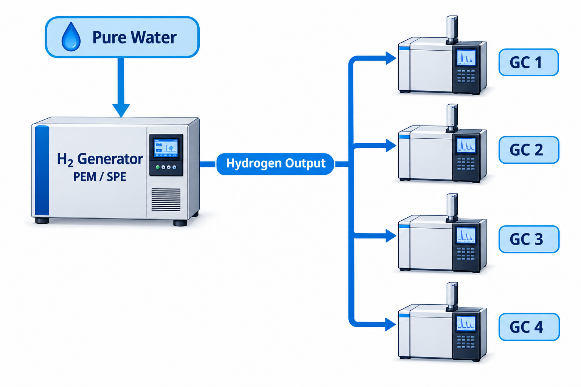
This arrangement can simplify gas supply management. However, the generator must have sufficient capacity and the distribution system must be properly designed. Pressure regulation, gas purity, tubing materials, connections and leak detection all become important considerations.
Advantages of hydrogen generators
1. Hydrogen is produced on demand
The generator produces hydrogen when required.
This eliminates the need to maintain a regular supply of replacement cylinders.
2. Reduced cylinder handling
Laboratory personnel do not need to routinely move and replace hydrogen cylinders.
This can simplify laboratory operations.
3. Reduced stored hydrogen inventory
A generator does not store a large cylinder volume of compressed hydrogen at the point of use. This can be an important consideration for laboratories where minimising stored hydrogen is desirable. However, hydrogen generated on demand remains flammable and must be treated as a hazardous gas. A generator does not eliminate the need for appropriate laboratory safety procedures.
4. Continuous supply
A correctly sized generator can produce hydrogen continuously for connected instruments. This can be particularly convenient for laboratories where GC instruments operate frequently or continuously.
5. Potentially lower long-term supply costs
For laboratories with substantial hydrogen consumption, producing hydrogen from water and electricity may reduce recurring cylinder supply costs.
However, this should be evaluated using the actual:
- Hydrogen consumption
- Cylinder rental
- Cylinder delivery
- Hydrogen purchase cost
- Electricity cost
- Water consumption
- Generator maintenance
- Generator replacement cost
A simple comparison is annual cylinder cost versus annual generator operating cost + annualised generator capital cost.
The result will vary significantly between laboratories.
Advantages of hydrogen cylinders
Hydrogen cylinders also have important advantages.
1. Simple established technology
Cylinder-based gas supply is well understood in analytical laboratories.
2. No electricity required to produce hydrogen
The gas is already available in the cylinder. This can be useful where electrical power is unreliable or unavailable.
3. High gas storage capacity
A cylinder can contain a substantial quantity of hydrogen compared with the immediate output capacity of a small laboratory generator.
4. Suitable for occasional use
For laboratories that use hydrogen only occasionally, purchasing or renting a generator may not provide an economic advantage.
A cylinder may be simpler for intermittent applications.
Safety considerations
Safety is one of the most important considerations when comparing hydrogen supply systems. Hydrogen is:
- Highly flammable
- Very light
- Capable of forming flammable mixtures with air
- Difficult to detect without suitable instrumentation because it is colourless and odourless
Both cylinder systems and hydrogen generators therefore require appropriate engineering controls.
Hydrogen cylinders and safety
Cylinder installations require consideration of:
- Cylinder storage
- Cylinder restraints
- Regulators
- Pressure relief
- Gas connections
- Tubing
- Leak detection
- Ventilation
- Cylinder transport
- Emergency procedures
Laboratories should follow applicable safety requirements and the instructions of the gas supplier and equipment manufacturer.
Hydrogen generators and safety
A generator does not make hydrogen inherently safe.
The system still contains and produces flammable hydrogen.
A laboratory hydrogen generator should therefore incorporate appropriate safety features such as, where applicable:
- Hydrogen leak detection
- Pressure monitoring
- Automatic shutdown
- Over-pressure protection
- Water-level monitoring
- Fault indication
- Appropriate ventilation
- Controlled gas output
The exact safety architecture depends on the generator design.
Water quality is critical for PEM/SPE generators. PEM/SPE hydrogen generators use water as the feedstock. Water quality can have a significant effect on generator performance and service life. Depending on the manufacturer's specification, the generator may require:
- Milli-Q water
- Deionised water
- Redistilled water
- Other specified high-purity water
Tap water should not be used unless the equipment manufacturer specifically permits it.
Minerals and contaminants in unsuitable water can affect the electrochemical system and may reduce performance or damage components. The manufacturer's specified water quality should always be followed.
Generator maintenance
A hydrogen generator is not maintenance-free.
Depending on the design, maintenance may include:
- Water replacement or replenishment
- Water-quality checks
- Filter replacement
- Desiccant replacement
- Leak testing
- Inspection of tubing and connections
- Periodic servicing
- Membrane or cell maintenance
Maintenance requirements vary significantly between generator designs.
The operating manual should therefore be treated as the primary source for maintenance intervals and procedures.
Gas purification
Some GC applications may require additional purification between the hydrogen source and the instrument. Purification systems can address contaminants such as:
- Moisture
- Oxygen
- Hydrocarbons
- Other trace contaminants
Whether additional purification is required depends on the hydrogen source, generator specification and GC application. A high-purity generator may already provide gas suitable for the intended application, but this should be verified against the instrument and analytical method requirements.
Reliability: cylinder vs generator
Reliability should be considered at the system level. A cylinder supply can continue until the cylinder is depleted, provided the supply system remains functional. The main operational risk is often running out of gas. A generator can continue producing hydrogen as long as:
- Electrical power is available
- Water is available
- The generator is operating correctly
- Required maintenance has been performed
- The connected gas demand remains within its rated capacity
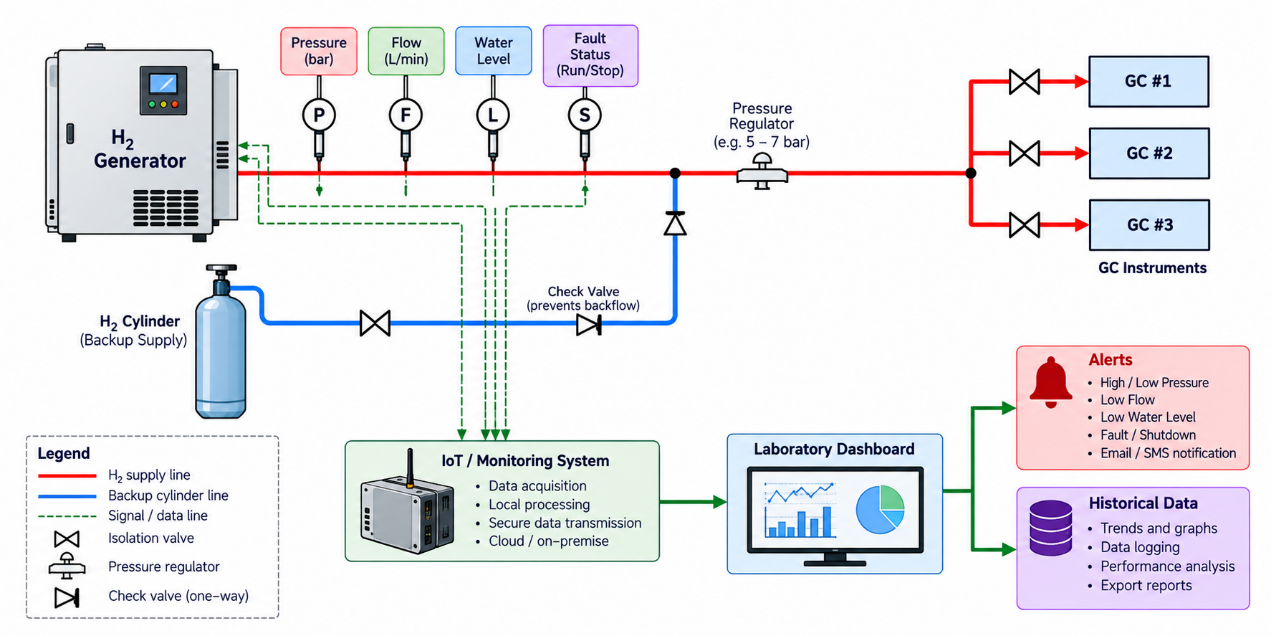
A generator may therefore benefit from monitoring of:
- Hydrogen pressure
- Output flow
- Water level
- Generator status
- Fault conditions
For critical applications, redundancy or backup hydrogen supply may also be considered.
What happens during a power failure?
This is an important difference between the two approaches. A cylinder does not require electricity to contain hydrogen. A hydrogen generator requires electrical power to produce hydrogen. If the laboratory experiences a power failure, hydrogen generation will normally stop. For critical GC applications, possible approaches include:
- Backup power
- UPS systems where appropriate
- Standby hydrogen supply
- Multiple generators
- Controlled shutdown procedures
The appropriate solution depends on the criticality of the analytical process.
Space requirements
Laboratory space can influence the decision.A cylinder-based system requires suitable space for:
- Gas cylinders
- Cylinder restraints
- Regulators
- Gas lines
- Potential gas cabinets or storage arrangements
A generator requires space for the generator itself and sufficient access for operation and maintenance. For laboratories with limited space, the physical footprint of the complete gas-supply system should be considered rather than comparing only the dimensions of the generator and cylinder.
Which option is more economical?
There is no universal answer. The economic comparison depends on the laboratory's hydrogen consumption. A useful analysis should consider:
Cylinder system
- Hydrogen purchase price
- Cylinder rental
- Delivery charges
- Cylinder replacement
- Storage infrastructure
- Regulator and gas-line maintenance
Generator system
- Generator purchase price
- Installation
- Electricity
- High-purity water
- Maintenance
- Consumables
- Replacement components
- Generator service life
For a laboratory using several GC instruments every day, a generator may offer attractive economics. For occasional GC use, cylinders may remain a practical option.
Hydrogen generator sizing
Generator capacity is normally specified in terms of hydrogen production rate, such as a flow rate. The required capacity should be calculated from the connected instruments.
For example:
| Application | Hydrogen demand |
|---|---|
| GC 1 carrier gas | 100 mL/min |
| GC 1 FID | 40 mL/min |
| GC 2 carrier gas | 100 mL/min |
| GC 2 FID | 40 mL/min |
| GC 3 carrier gas | 100 mL/min |
| GC 3 FID | 40 mL/min |
| Total | 420 mL/min |
The generator should not necessarily be selected at exactly the calculated demand.
An appropriate engineering margin should be included, and the generator's rated operating conditions should be checked. The example above is illustrative only. Actual GC flow requirements must be obtained from the instruments and analytical methods being used.
Comparing operating requirements
| Factor | Cylinder | Hydrogen Generator |
|---|---|---|
| Supply method | Stored compressed gas | On-demand generation |
| Electricity | Not required for gas production | Required |
| Water | Not required | High-purity water |
| Cylinder logistics | Required | Minimized |
| Gas storage | Relatively high | Relatively low |
| Generator maintenance | Not applicable | Required |
| Scalability | Add cylinders/manifold | Select appropriate generator capacity |
| Continuous operation | Yes, while gas remains | Yes, within generator capacity |
| Power failure | Gas remains available | Hydrogen production stops |
| Initial investment | Usually lower | Usually higher |
| Long-term economics | Depends on consumption | Depends on consumption |
| Safety management | High-pressure cylinders | Hydrogen generation system |
When should a laboratory consider a hydrogen generator?
A hydrogen generator may be worth considering when:
- GC instruments operate frequently
- Hydrogen consumption is relatively high
- Several instruments require hydrogen
- Cylinder replacement is inconvenient
- Laboratory space is limited
- Continuous hydrogen availability is important
- Reducing cylinder handling is desirable
- The laboratory wants on-demand hydrogen production
- There is reliable electricity and access to suitable water
When might cylinders be appropriate?
Cylinder supply may be appropriate when:
- Hydrogen consumption is low
- GC operation is intermittent
- A laboratory already has established cylinder infrastructure
- Electrical power is unreliable
- A portable supply is required
- The cost of a generator cannot be justified by the gas consumption
The choice should be based on the laboratory's actual operating requirements rather than assuming that one technology is universally better.
A hybrid approach
Some laboratories may choose to combine the two approaches.
For example:
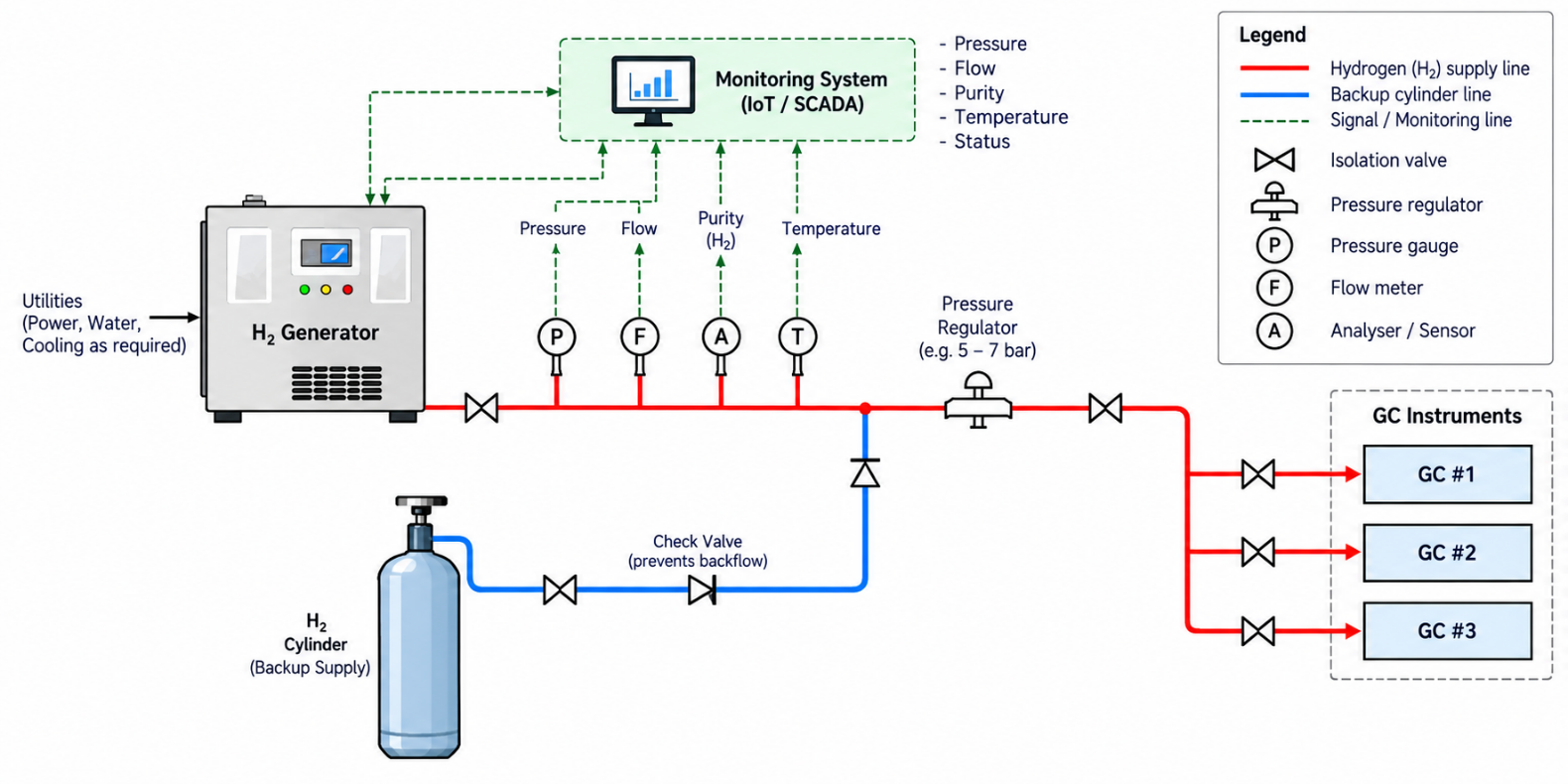
The generator can provide the normal hydrogen supply, while a backup cylinder can provide contingency supply where appropriate.
The design of such a system needs careful consideration of pressure regulation, isolation, changeover arrangements, safety and the GC manufacturer's requirements.
Questions to ask when selecting a hydrogen generator
Before purchasing a generator, a laboratory should consider:
What hydrogen purity is required?
Check the GC manufacturer's specifications and analytical method requirements.
What is the required flow?
Calculate the combined hydrogen demand of all connected instruments.
What output pressure is required?
Ensure that the generator can meet the required operating pressure.
What water quality is required?
Confirm the manufacturer's specification and availability of suitable high-purity water.
What happens if power is lost?
Determine whether backup supply or an alternative operating procedure is required.
What maintenance is required?
Understand consumables, servicing and expected replacement intervals.
What safety features are included?
Consider leak detection, automatic shutdown, pressure protection and fault monitoring.
Can the generator be expanded?
Consider future GC installations and additional hydrogen demand.
Hydrogen generation as part of laboratory automation
A modern laboratory can integrate hydrogen generation with broader laboratory monitoring. For example:
This can allow laboratory personnel to monitor not only the GC instruments but also the condition of the gas-generation system. Such monitoring can provide early warning of conditions that require attention.
Final considerations
The decision between a hydrogen generator and gas cylinders should be based on the complete laboratory operating environment. There is no single solution that is appropriate for every GC laboratory. Gas cylinders provide a familiar and straightforward source of hydrogen, particularly for laboratories with low or intermittent consumption. Hydrogen generators provide on-demand production and can be particularly attractive for laboratories operating multiple GC instruments or consuming hydrogen continuously. The decision should consider:
Gas demand + purity + reliability + safety + laboratory space + maintenance + operating cost
rather than purchase price alone. For laboratories considering a transition from cylinders to hydrogen generation, a useful first step is to document the hydrogen consumption of each GC and detector, calculate the total demand, identify the required purity and pressure, and then compare the complete lifecycle cost of the two systems.
Practical checklist
Before selecting a hydrogen supply system for GC:
- List all GC instruments
- Identify which instruments use hydrogen
- Identify carrier-gas and detector-gas requirements
- Calculate total hydrogen consumption
- Determine required hydrogen purity
- Determine required output pressure
- Consider future instrument expansion
- Evaluate cylinder storage requirements
- Evaluate generator space requirements
- Confirm availability of suitable high-purity water
- Evaluate electrical-power requirements
- Consider backup supply requirements
- Review hydrogen leak detection and safety arrangements
- Compare maintenance requirements
- Compare total lifecycle cost
- Check compatibility with the GC manufacturer's requirements
- Establish appropriate gas-leak testing and maintenance procedures