Where Should Indoor Air Quality Sensors Be Installed?
A practical guide to positioning indoor air quality sensors in offices, schools, laboratories, commercial buildings and other occupied spaces
Indoor air quality (IAQ) sensors help facility managers track building conditions and investigate ventilation and pollution problems. But where the sensor sits affects what it measures. A unit beside a supply-air outlet, an open window, a cooking appliance or a person's face may not represent the air most occupants breathe. This guide explains how to choose sensor locations for different buildings.
1. What Does an Indoor Air Quality Sensor Measure?
The term "indoor air quality sensor" can refer to several different types of sensors.
A typical IAQ monitoring system may measure:
- Carbon dioxide (CO₂)
- Temperature
- Relative humidity
- Particulate matter (PM1, PM2.5 and PM10)
- Volatile organic compounds (VOCs)
- Carbon monoxide (CO)
- Formaldehyde
- Other gases or pollutants
The appropriate installation location depends partly on what is being measured.
For example, a CO₂ sensor is primarily useful for understanding conditions associated with occupancy and ventilation, whereas a particulate-matter sensor may need to be positioned differently if the objective is to identify particles entering from outdoors.
Therefore, the first question should be: What do we want the sensor to tell us?
2. The Most Important Principle: Measure the Air People Breathe
For general indoor air quality monitoring, the objective is usually to measure conditions representative of the occupied zone. The sensor should therefore be installed where it can reasonably represent the air experienced by occupants.
A good location generally has:
- Normal room air circulation
- Representative occupancy
- Adequate clearance around the sensor
- No direct airflow from an air-conditioning outlet
- No immediate local pollution source
- No unusual heat source
- No direct sunlight
The sensor should not be hidden inside a cupboard, behind furniture or inside a confined enclosure.
3. Typical Wall-Mounted Sensor Location
For general room monitoring, a wall-mounted sensor is often installed near breathing-zone height. Many installations use approximately 1.1–1.7 metres above the floor as a starting point.
The exact height should be determined by the application, sensor design and relevant building or monitoring guidance. The sensor should also be positioned where occupants are normally present rather than immediately beside the ceiling or floor.
For example:
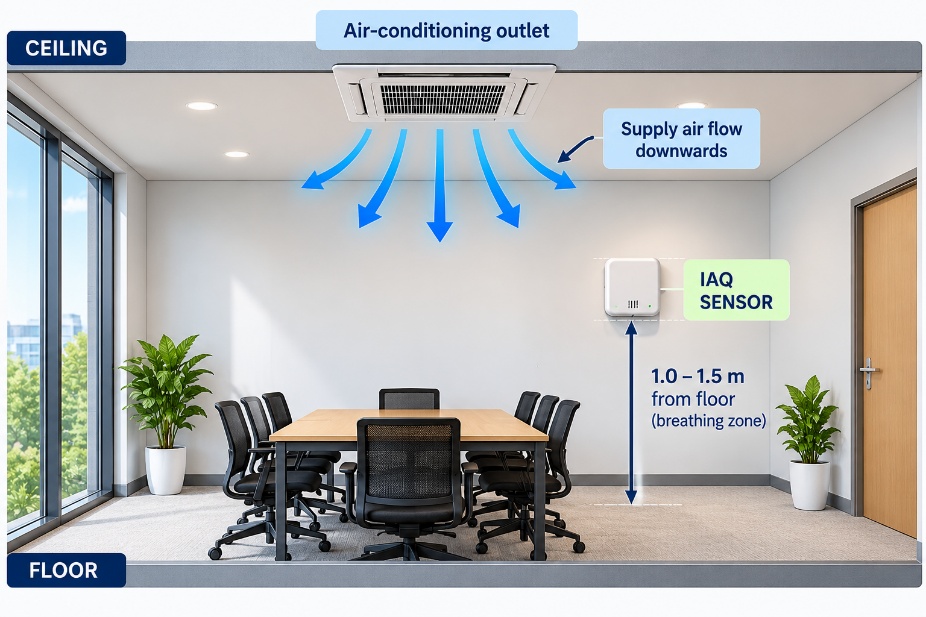
The sensor should be located away from the direct air stream from the HVAC outlet.
4. Avoid Installing the Sensor Directly Beside an Air Outlet
One of the most common installation errors is placing an IAQ sensor immediately next to an air-conditioning supply diffuser. Air coming directly from the HVAC system may have:
- Different temperature
- Different humidity
- Different CO₂ concentration
- Different particulate concentration
Those conditions can differ from the occupied zone. A sensor in the direct supply-air stream may not represent the conditions occupants experience.
Better approach
Place the sensor in the occupied area, away from the direct supply-air jet.
The same principle applies to:
- Ceiling diffusers
- Wall-mounted air outlets
- Fan coil units
- Portable air cleaners
- Exhaust outlets
5. Do Not Install the Sensor Directly Beside an Open Window
An open window can introduce outdoor air directly into the sensor.
This can be useful if the objective is to measure outdoor air infiltration, but it is generally not the best location for measuring the normal indoor environment.
Avoid placing a general-purpose IAQ sensor:
- Directly beside an open window
- Immediately beside an external door
- Next to a permanently open ventilation opening
Avoid these locations unless the measurement specifically requires them.
6. Avoid Doors and High-Traffic Areas
Doors can create significant local air movement. Every time a door opens, air can move between:
- Indoor and outdoor environments
- Adjacent rooms
- Corridors
- Stairwells
- Different pressure zones
Similarly, a sensor located immediately beside a busy doorway may be exposed to unusual airflow and transient conditions. For general IAQ monitoring, position the sensor away from major traffic paths where practical.
7. Keep Sensors Away from Local Pollution Sources
A sensor should not normally be positioned immediately beside a local source of pollution unless that source is specifically what you want to monitor.
Examples include:
- Cooking equipment
- Printers
- Photocopiers
- Cleaning-chemical storage
- Solvent use
- Aerosol products
- Industrial processes
- Vehicle exhaust
- Waste containers
For example, a PM2.5 sensor placed directly beside a printer may report a local particle concentration that is not representative of the room as a whole.
8. Do Not Place Sensors Behind Furniture
Large furniture can interfere with air movement. Avoid installing sensors:
- Behind cabinets
- Inside bookshelves
- Behind curtains
- Behind large displays
- Under desks
- Inside cupboards
The sensor needs access to the surrounding room air. A sensor enclosure may contain small openings designed specifically to allow air to reach the sensing elements.
Those openings should remain unobstructed.
9. Keep Sensors Away From Direct Sunlight
Temperature sensors are particularly sensitive to local heat sources. Direct sunlight can heat the sensor enclosure and cause the temperature measurement to differ significantly from the actual room air temperature. Avoid placing sensors:
- In direct sunlight
- Immediately beside windows receiving strong sunlight
- Above radiators
- Beside heaters
- Above electronic equipment producing significant heat
The same principle applies to other local heat sources.
10. Consider Occupancy When Choosing the Location
The sensor location should reflect the purpose of the monitoring system. An office with ten occupants may require a different sensor arrangement from a meeting room that occasionally contains fifty people. For example:
Individual office
One appropriately positioned sensor may be sufficient.
Open-plan office
Several sensors may be necessary if the area is large or has different ventilation zones.
Meeting room
A sensor should be located where it can represent the air experienced by occupants.
Classroom
The sensor should be positioned to represent the occupied space rather than directly beside the teacher's desk or ventilation outlet.
11. CO₂ Sensors Need Special Consideration
CO₂ is one of the most commonly monitored indoor-air-quality parameters. Human occupants continuously produce CO₂, so indoor concentrations can provide useful information about occupancy and ventilation conditions. However, CO₂ concentration can vary significantly within a building. For example:
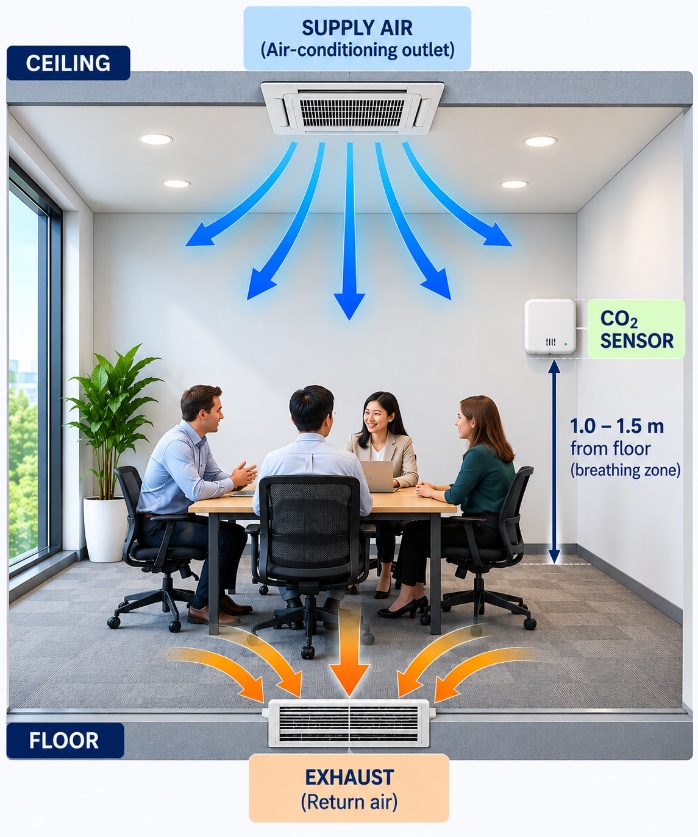
A sensor located immediately beside the supply-air outlet may indicate lower CO₂ than the occupied area. A sensor positioned immediately beside a person's face may indicate higher CO₂ because it is measuring exhaled air. For general room monitoring, the objective should be a representative measurement of the occupied space.
12. Do Not Put a CO₂ Sensor Directly in Front of a Person
Human breath contains a much higher concentration of CO₂ than typical room air.
If a person repeatedly breathes directly onto a sensor, the measured concentration can become artificially elevated. Therefore, avoid installing the sensor:
- Directly in front of a person's face
- Immediately beside a person's chair
- On a desk where someone continuously works directly beside it
The sensor should measure room air rather than an individual's exhaled breath.
13. Where Should PM2.5 Sensors Be Installed?
Particulate-matter sensors require additional consideration because particle concentrations can change rapidly in response to local sources. PM sensors may be useful for monitoring:
- PM1
- PM2.5
- PM10
Potential sources include:
- Outdoor pollution
- Cooking
- Dust
- Cleaning activities
- Combustion
- Printing
- Industrial processes
For general room monitoring, the sensor should be installed where it receives representative room air. If the objective is to identify a particular source, however, a dedicated sensor may intentionally be installed closer to that source. This distinction is important:
Choose the location to match the monitoring objective.
14. VOC Sensors
VOC sensors are commonly used to monitor changes associated with volatile organic compounds and general indoor-air-quality conditions. Potential sources include:
- Cleaning products
- Paints
- Adhesives
- Solvents
- Furnishings
- Personal-care products
- Building materials
VOC sensors should normally be positioned away from a single local source if the objective is to measure general room conditions. If the objective is source identification, a different strategy may be appropriate.
15. Temperature and Humidity Sensors
Temperature and relative humidity measurements can be strongly affected by local conditions. Avoid positioning the sensor:
- Beside heating equipment
- In direct sunlight
- Immediately above electronic equipment
- Directly in an HVAC supply stream
- Against cold external surfaces where condensation may occur
For building monitoring, it is often useful to measure temperature and humidity at the same general location as the IAQ measurements.
16. How Many Sensors Does a Building Need?
There is no single number that applies to every building. The required number depends on:
- Building size
- Number of occupants
- Room layout
- HVAC zoning
- Occupancy patterns
- Building use
- Airflow patterns
- Pollution sources
- Monitoring objectives
A single sensor may be appropriate for a small room. A large building may require many sensors.
Example
Consider a commercial building containing:
- Reception
- Open-plan office
- Three meeting rooms
- Laboratory
- Kitchen
- Storage area
A possible deployment could be:
| Area | Possible monitoring approach |
|---|---|
| Reception | 1 IAQ sensor |
| Open-plan office | Multiple sensors depending on size and HVAC zones |
| Meeting rooms | One sensor per significant room |
| Laboratory | Application-specific monitoring |
| Kitchen | Dedicated monitoring strategy |
| Storage | Sensor if environmental conditions require monitoring |
The exact design should be based on the building and monitoring objectives rather than simply installing one sensor per arbitrary number of square metres.
17. Use Multiple Sensors to Understand a Large Building
Large buildings often have significant spatial variation. For example, one part of a building may have:
- High occupancy
- Poor ventilation
- High CO₂
while another area may have:
- Low occupancy
- Strong ventilation
- Low CO₂
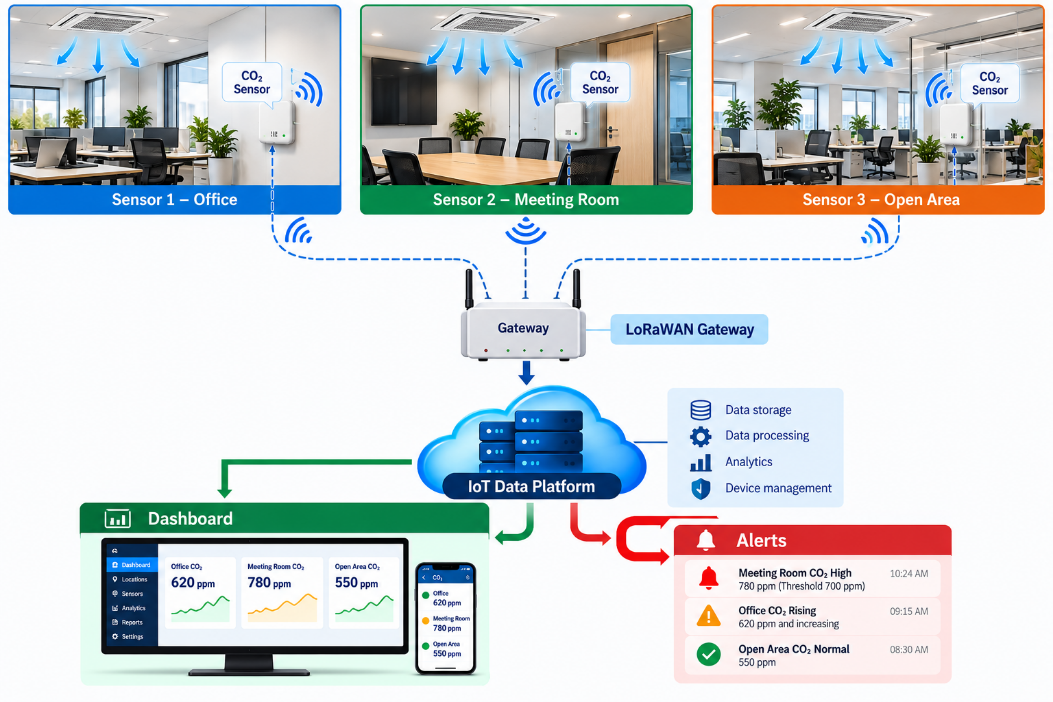
A single sensor may miss these differences. Multiple networked sensors help facility managers compare conditions across the building.
18. Indoor Air Quality Sensors in Schools
Schools require particular attention because occupancy can change substantially throughout the day. Potential monitoring locations include:
- Classrooms
- Libraries
- Laboratories
- Staff rooms
- Assembly areas
- Indoor sports facilities
A classroom sensor should normally be positioned to represent the occupied space rather than being placed immediately beside a ventilation outlet or window.
Continuous monitoring can help identify changes associated with:
- Occupancy
- Ventilation
- Weather
- Room use
- HVAC operation
19. Indoor Air Quality Sensors in Offices
Modern offices can contain open-plan areas, meeting rooms, enclosed offices and shared facilities. IAQ monitoring can help building operators understand how conditions change throughout the working day. For example, a meeting room may experience:
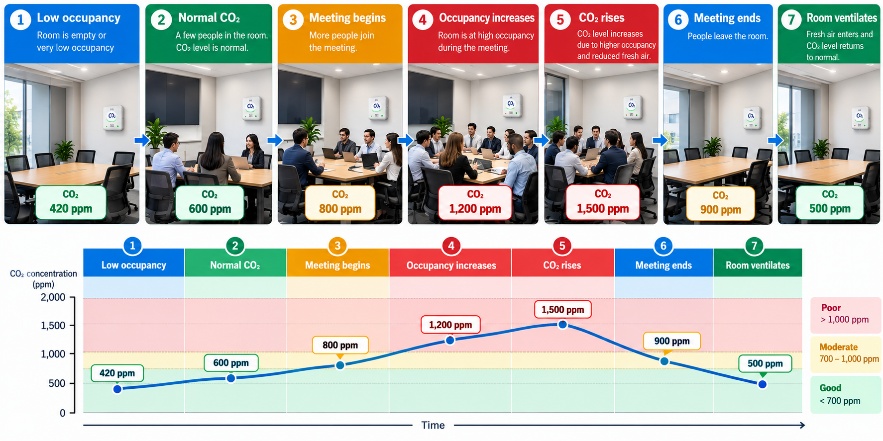
A networked sensor can make this pattern visible to building operators.
For broader monitoring guidance, see Indoor Air Quality Monitoring for Australian Offices.
20. Sensor Placement in Laboratories
Laboratories require a different approach. Laboratory environments may contain:
- Chemicals
- Solvents
- Fume cupboards
- Local exhaust systems
- Specialised ventilation
- Process equipment
A general-purpose IAQ sensor should not be considered a substitute for dedicated laboratory safety monitoring. Sensor placement should be determined according to the specific hazards and objectives of the laboratory. Where hazardous gases are involved, appropriate specialised detection equipment and professional engineering assessment may be required.
21. LoRaWAN-Based Indoor Air Quality Monitoring
For large buildings, wireless IoT technologies such as LoRaWAN can simplify the deployment of distributed IAQ sensors. Instead of running communication cables to every sensor, sensors can transmit data wirelessly to a centrally located LoRaWAN gateway. A typical system can look like:
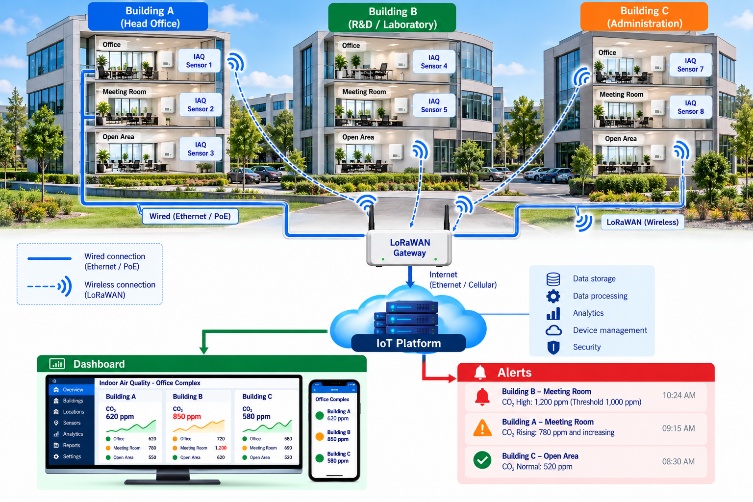
This architecture can be particularly useful when a building needs a large number of monitoring points.
For gateway setup and AU915 configuration, see How to Set Up a LoRaWAN Gateway in Australia.
22. What Should Be Displayed on the Dashboard?
Collecting sensor data is only the beginning. A useful IAQ system should make the information easy to understand. A dashboard might display:
- Current CO₂
- PM2.5
- Temperature
- Relative humidity
- VOC measurements
- Historical trends
- Sensor status
- Battery level
- Communication status
Trend information can often be more useful than a single instantaneous measurement.
For example, a graph showing CO₂ over an entire working day can reveal patterns that are not obvious from a single reading.
23. Use Data to Identify Building Problems
A distributed sensor network can help identify potential problems such as:
- Poor ventilation
- Overcrowded rooms
- HVAC faults
- Uneven air distribution
- Excessive humidity
- Local pollution sources
- Unexpected temperature variation
The purpose of monitoring should therefore not simply be to collect numbers.
The real value comes from using the information to understand how the building behaves.
24. A Practical Sensor Placement Checklist
Before installing an indoor air quality sensor, ask:
Location
- Is this a representative occupied area?
- Is the sensor exposed to normal room air?
- Is it away from direct sunlight?
- Is it away from heating equipment?
- Is it away from direct HVAC supply air?
- Is it away from doors and windows?
- Is it away from local pollution sources?
- Is it unobstructed?
Monitoring objective
- What parameter are we measuring?
- Why are we measuring it?
- Is the location appropriate for that parameter?
- Are additional sensors required?
Building
- What are the HVAC zones?
- Where are occupants normally located?
- Are there significant differences between rooms?
- Are there known pollution sources?
IoT system
- Is wireless connectivity reliable?
- Is the sensor powered appropriately?
- Is the gateway located correctly?
- Is the data being stored?
- Are alerts configured appropriately?
25. The Golden Rule of IAQ Sensor Placement
The simplest rule is:
Install the sensor where its measurements represent the environment you want to understand. There is no single correct location for every sensor.
A sensor designed to monitor general room conditions should normally be placed in the occupied zone and away from unusual local influences. A sensor designed to identify a pollution source may intentionally be installed close to that source.
Understanding this distinction is fundamental to designing a useful indoor air-quality monitoring system.
Conclusion
Indoor air quality sensors can provide valuable information about the conditions inside offices, schools, laboratories, commercial buildings and other occupied environments. But the quality of the information depends heavily on sensor placement. For general IAQ monitoring:
- Install sensors in representative occupied areas.
- Position them at an appropriate breathing-zone height.
- Keep them away from direct HVAC airflow.
- Avoid direct sunlight and local heat sources.
- Avoid placing sensors immediately beside doors and windows.
- Keep sensors away from local pollution sources unless source monitoring is the objective.
- Ensure the sensor has unobstructed access to room air.
- Use multiple sensors where building size, occupancy or HVAC zoning creates significant spatial variation.
Larger buildings can use wireless technologies such as LoRaWAN to connect distributed sensors to a gateway and IoT platform. This gives building operators a way to compare conditions across rooms and HVAC zones and investigate problems using recorded data.